When Geraldine Ferraro ran for vice president in 1984, I had no idea what it meant to be a feminist and to be limited as a member of a marginalized group. But I did have the impression that Ferraro must have been a Very Bad Person, based on the people talked about her, both in terms of content and tone. It didn't occur to me that her gender had anything to do with it. Her passing on the weekend provides me with an opportunity to reflect on how little I understood at the time about her and what she did for us.
That year, I was thirteen years old and in grade eight. I was not following politics at all. To me, the most significant event on the world stage was the birth of UK's Prince Harry in September. I knew that there was a presidential election in the US and who candidates were. I knew that Geraldine Ferraro was running. I had no idea what the issues were in the election. But I did have the impression that Ferraro must be a Very Bad Person.
The news was always critical. She had said the wrong thing. She was doing things she shouldn't have. Her past was questionable. More damaging than the facts were the implications, which read like a laundry list of words to marginalize someone: incompetent, immoral, not Christian, too uppity, exceeding her capabilities... The adults around me (both men and women) seemed to feel a sense of outrage; how dare she run for Vice President!
It did not strike me as remarkable that a woman was running for the position. I had the mistaken idea that the world always was and will be this way. It didn't occur to me that people expressed these sentiments about her, because she was a woman. I had the mistaken idea that men and women had equal opportunity in our society.
To give you an idea of how unenlightened I was, let me tell you about the most memorable scene (to me) from the move Top Gun. Maverick (Tom Cruise) had kept Charlie (Kelly McGillis) waiting, because he stayed to play beach volleyball with his mates. When Maverick arrived at Charlie's place, he made weak excuses and asked her to wait some more while he had a shower. Charlie said no and made him talk to her un-showered. This scene amazed me, because it was an example of a woman not letting a man get away with bad behavior. In my daily life, male relatives often acted badly, and women just put up with it. It never occurred to me that there was something that we could do about it.
But, in a sense, there wasn't anything we could do about it. On one occasion, I did resist and it didn't work out well. My brother, sister, and I were supposed to take turns making lunch to bring to school. My brother, being the youngest and the only son, often shirked his duties with little reprimand from our parents. The job was often left to me and my sister. We probably should have just not made his lunch until he pitched in. But that was too blatant and would have drawn the ire of our parents. My sister and I hatched a plan: we would make his sandwich inside-out with the bread in the middle, the meat on the outside, and the condiments on top. We giggled like fiends as we prepared this messy revenge. When my brother came home, he was furious. (My husband says that it was probably because we embarrassed him in front of his friends.) He raged and yelled at us. And what did we do? We did what we saw our female role models did. We acquiesced and didn't do it again. It's astonishing, now that I look back on it. The me in 2011 would never put up with something like this. I don't think we did our brother any favors either.
Reading Ferraro's obituary gave me a new appreciation for what she did and how far I have come. I know what it's like to be under attack. I know what it's like to have special attacks lobbed at me with astonishing vitriol, because I was a woman and I dared. She held up remarkably against the barrage of attacks. She opened up possibilities for women who followed. Rest in peace, Geraldine Ferraro.
Showing posts with label food. Show all posts
Showing posts with label food. Show all posts
Monday, March 28, 2011


Friday, March 4, 2011
Is making our food supply chain smarter a smart way to spend our money?
I've been watching a lot of TED talks lately and it's not uncommon for there to be a sponsor ad either at the beginning or end of the video. Consequently, I've seen the following ad about making our food supply chain smarter quite a few times.
At first, I was impressed by the coolness of the technology. If we're losing 25% of our food to spoilage in transit, it seems reasonable to use technology to improve the situation. If we could decrease the spoilage, then maybe we could feed more people. I could certainly hear my mother's voice chastising me about letting food go to waste. Besides, working on our food chain would be much more interesting and socially relevant than working on software for a bank, or (shudder) a weapons system.
But then, I had the opportunity to see the ad again... and again... and a few more times. And then it dawned on me... If we're losing 30% of our food in transit, then isn't the problem the transit? Maybe we shouldn't be transporting our food quite so far, then less of it would spoil. Maybe the problem is that we live in cities and are so divorced from our food production systems. Locavores have already recognized this problem and are working on it. Others, including Michelle Obama, are planting on urban vegetable gardens to promote healthy eating.
These ideas crystallized when I saw the following infographic from Good magazine.

According to the USDA, farmers are receiving less than $0.16 out of every dollar that we spend on food. The rest goes to "marketing," which is not advertising, but rather "the entire system that links farms to consumers, including transportation, processing, and distribution." Good's food editor, Nicola Twilley, goes on to write, "In other words, the infographic above means that we spend five times as much on getting our food from farm to table as we do on actually growing it."
So, the ad on making our food supply chain smarter is actually advocating more money in the marketing side of food production. Is this cool? Not so much.
At first, I was impressed by the coolness of the technology. If we're losing 25% of our food to spoilage in transit, it seems reasonable to use technology to improve the situation. If we could decrease the spoilage, then maybe we could feed more people. I could certainly hear my mother's voice chastising me about letting food go to waste. Besides, working on our food chain would be much more interesting and socially relevant than working on software for a bank, or (shudder) a weapons system.
But then, I had the opportunity to see the ad again... and again... and a few more times. And then it dawned on me... If we're losing 30% of our food in transit, then isn't the problem the transit? Maybe we shouldn't be transporting our food quite so far, then less of it would spoil. Maybe the problem is that we live in cities and are so divorced from our food production systems. Locavores have already recognized this problem and are working on it. Others, including Michelle Obama, are planting on urban vegetable gardens to promote healthy eating.
These ideas crystallized when I saw the following infographic from Good magazine.
According to the USDA, farmers are receiving less than $0.16 out of every dollar that we spend on food. The rest goes to "marketing," which is not advertising, but rather "the entire system that links farms to consumers, including transportation, processing, and distribution." Good's food editor, Nicola Twilley, goes on to write, "In other words, the infographic above means that we spend five times as much on getting our food from farm to table as we do on actually growing it."
So, the ad on making our food supply chain smarter is actually advocating more money in the marketing side of food production. Is this cool? Not so much.
Wednesday, September 10, 2008
Gluten-free and lactose-free eating in Milan
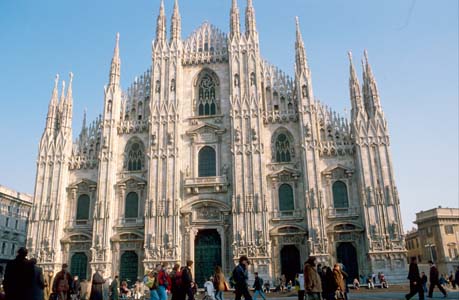
I've been in Milan, Italy since the weekend and I've had a terrific time. This is noteworthy because it's surprising for two reasons.
1) I have not enjoyed previous trips to Italy, because I found the country to be disorganized and chaotic. Milan is different. It's a world city, like New York. It's very cosmopolitan, and people are business-like, but nice. Drivers actually stop for you, unlike in Rome and Naples where it's the pedestrian's responsibility to get away. (The traffic is still pretty hairy, but this is due mostly to the scooters who act like bicycles, but move at car-like speeds and to the bicycles who act like pedestrians, but move at sprinting speeds.) Milan also seems like a very safe city. There are lots of women taxi drivers, a phenomenon that I have not seen anywhere else.
In addition, Milan has a great transit system (streecars, buses, and subway), so I have been to many parts of the city.
Coincidentally, a story appeared on BBC NEWS reporting that the Dante Alighieri Society (similar to the Academie Francaise) are calling on Italians to use less English. Words like leadership, weekend, OK, and know-how are being used part of the common language. I had noticed the phenomenon in my time here. Since I only speak guide book Italian, I definitely notice when an English work or phrase pops up. It's similar to listening to francophones in Montreal, but with a lower proportion of English overall.
2) I have a long list of things I can't eat. I can't have gluten, lactose, or caffeine, otherwise Bad Things Happen. Also, I'm supposed to stay away from sugar, starches, and saturated fats because I have high cholesterol and high triglycerides. This doesn't leave much that I can eat-- mostly green leafy vegetables. I can compromise on the second set, but not the first. Italian food is particularly problematic for me with the bread, pasta, pizza, and cheese.
Amazingly, I have been able to find things to eat. Around the corner from the hotel is a very nice grocery store, Esselunga, which has a more than adequate selection of soy products. They also have a selection of prepared foods with a complete ingredient list, so I have been eating from there quite happily.
Yesterday, I discovered a shop, Vivere Meglio, across the street with lactose-free gelato. Yum!
Last night, I discovered a web site with listings of places that have gluten-free pizza. Today, I went on to two of the most highly rated restaurants. For lunch, I went to Be Bop, which was in an area similar to Queen Street West in Toronto. Despite its name, there was classical music playing at Be Bop. Any pizza on the menu could be prepared with a gluten-free crust. I had a wood fired, thin crust veggie pizza (mmm) and lemon sorbetto for dessert. For dinner, I went to Le Specialità, where any pizza or pasta could be made gluten-free and they had dessert options too. I had a very large Pizza Duo Stagione (mushrooms and prosciutto) and Gnocci Frutta di Mare (!!!). For dessert, I had a tart with white chocolate and wild strawberries. I was extremely full and extremely happy.
It's a good thing that I hadn't discovered these places before, because I'd be going home round!
Subscribe to:
Posts (Atom)