Showing posts with label people. Show all posts

Thursday, April 7, 2011

Colonized without Our Consent


  ARTHUR:  How do you do, good lady.  I am Arthur, King of the Britons.
      Who's castle is that?
  WOMAN:  King of the who?
  ARTHUR:  The Britons.
  WOMAN:  Who are the Britons?
  ARTHUR:  Well, we all are. we're all Britons and I am your king.
  WOMAN:  I didn't know we had a king.  I thought we were an autonomous
      collective.
  DENNIS:  You're fooling yourself.  We're living in a dictatorship.
      A self-perpetuating autocracy in which the working classes--
  WOMAN:  Oh there you go, bringing class into it again.
  DENNIS:  That's what it's all about if only people would--
  ARTHUR:  Please, please good people.  I am in haste.  Who lives
      in that castle?
  WOMAN:  No one live there.
  ARTHUR:  Then who is your lord?
  WOMAN:  We don't have a lord.
  ARTHUR:  What?
 Excerpt from Scene 3 from Monty Python and the Holy Grail

In Tuesday's post, I wrote about how corporations came into existence to allow aristocrats with property but no skills to participate in the mercantilist economy. Yesterday, I went further into the two characteristics of corporations, the profit motive and limited liability. Today, I'll get into the third characteristic, the imposition of a central authority into otherwise unregulated affairs.

The clip from Monty Python and the Holy Grail perfectly illustrates process of subjugation, or more broadly, colonization. Dennis and Woman are peasants, who didn't even know they had a king, let alone agreed to be subjects. Their village (or anarcho-syndicalist commune) had it's own organization, that worked just fine before Arthur came along. The imposition of centralized authority from outside turned them into subjects, or subjugated them. The process is the same when a corporation inserts itself into existing person-to-person, lateral relationships. But here, the process is called colonization.

What exactly is colonization?

From Nebraska Invasive Species Project
Biologically speaking, colonization is the process of a species coming to inhabit an area. The species populates and cultivates the area for its own purposes, and usually changes the biogeography as a result. Think invasive species. Human colonization is similar in that settlers are going into a region with existing inhabits and the settlers are imposing themselves on the people, geography, governance, and social order.

Scholars in science and technology studies use the concept in a more abstract way (surprise!). Colonization occurs when people impose an order on an existing phenomenon. For example, physicists colonize the building blocks of matter when they invent categories such as "atoms," "forces," and "quarks." In this view, geography is the not the only thing that can be colonized. Cultural practices and social arrangements can as well. For example, for-profit companies have colonized the open source software movement.

What does this have to do with corporations?

More than just dominating a geography, corporations inject themselves into existing social and cultural arrangements, and they centralize our economy. One example of how our lives have been colonized by corporations is the nuclear family.

Prior to the industrial revolution, people lived primarily in rural areas with an agrarian lifestyle. Goods were produced on a small scale by cottage industries. Customers and producers were typically members of the same community and had relationships outside of commerce. Corporations built ever larger factories that allowed them to take advantage of large steam plants, scale up production, and use less skilled workers in assembly lines. Workers were required to live in the city, away from their families, because machines and corporations required them to do so. Young people living in the city fall in love, as they are wont to do, get married, and have babies. Thus, we have nuclear families, consisting of a only parents and children, living far away from other relatives. To be clear, a corporation didn't decide that nuclear families should exist, only that it was in their economic best interest to have workers living near the factories.

In other words, our lives have been twisted around to suit a corporation's bottom line. They turn human beings into investors, workers, consumers, etc., which ignores their agency as family members, citizens, and stewards of the environment.

Is colonization still happening?

These days, countries aren't colonized by invaders anymore. (This is not to say that invasions don't happen, just that colonization through settlers and military force doesn't happen any more.) It's too expensive, not cool, and not necessary. Colonization now occurs through economic means. Why bother taking over the government, when you can take over Main Street AND make money? If citizens are drinking Starbucks, watching Hollywood movies, and listening to Lady Gaga, then what does it matter who is the Prime Minister or President?

Furthermore, the scale of colonization continues to grow. Living in a dominant culture in the USA, it's hard to see the colonization in our own lives. Perspectives from the periphery, such as the global South and developing nations, can be very enlightening. Firoze Manji, a Kenyan, is the editor-in-chief of Pambazuka News, an open-access, pan-African newsletter. In an interview, he was argued that the emphasis should be on emancipation, rather than economic development. He said:

I don't think the idea of development as the new name of colonialism is new: Nkrumah and others wrote about the process of neocolonialism – and the aid industry is very much part of the infrastructure of neocolonialism. What I think we should be outraged about is that what is called 'development' is in fact the use of public funds to subsidise and facilitate the work of the oligopolies, the transnational corporations who are the principal beneficiaries of functioning 'development'.

But I don't think this is colonialism: this is a form of imperialism, a way of extracting wealth from our countries, subsidised by public taxes. Imperialism has evolved over the last hundred years, and the accelerated financialisation of capital has created conditions in which there is a frantic drive for accumulation by dispossession. That is fundamentally what is going on.

And the aid industry is providing the oil to make that machinery work effectively in the interest of capital. Instead of using euphemisms like 'development', we should be calling it what it really is: Capitalism in the peripheries in the age of financialisation and the centralisation of capital on a global scale. This is important, because it allows clarity about what is going on, and at the same time poses the question: If accelerated pauperisation of the many is a characteristic of capitalism in the peripheries, what then should be the anti-capitalist alternative?

It seems that pauperisation doesn't occur only in the geographic peripheries, it's happening here to people who are on the periphery in other ways, such as wage, education, race, access to health care. What then should be the anti-corporatization alternatives? I'll be writing about those tomorrow.

Wednesday, April 6, 2011

Profit motive + limited liability == lack of empathy == psychopathic corporations

In yesterday's post, I talked about the three design principles behind the invention of the corporation-- the profit motive, limited liability, and centralization of existing person-to-person relations. In today's post, I'm going to further examine the implications of the first two.

Profit Motive

The desire to make money in and of itself is not a bad thing. It's a fact of life in our industrialized, urbanized lifestyle that we operate on a currency-based economy. Besides, who wouldn't want lots of money to spend on a big house, fancy vacations, and a top-of-the-line iPad 2. When money becomes the highest or even the only priority, the profit motive becomes problematic.  Some words that we would use to describe a person driven only by the profit motive include: greedy, materialistic, shallow, miserly. I, for one, wouldn't be eager to make friends with someone like this.

The situation is the same for corporations. The profit motive is not necessarily bad, but when coupled with an insensitivity to all other priorities it becomes downright evil.

Limited Liability

The intent of limited liability is to encourage new enterprise and innovation. The scheme helps corporations to locate capital, because the liability of the shareholders are limited to the amount that they contributed. In other words, members of the corporation can lose their initial stake, but they won't lose their other assets. This not entirely unreasonable, because large projects can have large risks, but are nonetheless worthwhile undertaking.

The problem with limited liability is it further exacerbates the negative consequences of the unfettered profit motive and further shields the corporation pressures to be more empathic to people. Limited liability is essentially a license for "one person to damage another person with impunity." Consequently, corporations can make as much profit as possible, with no regard for harm. To my knowledge, no such license is granted anywhere else in society. Even police, the military, and intelligence services are granted such license on an exceptional basis and under civilian oversight. Shareholders could provide similar oversight, but limited liability means that they don't have to. The worst thing that could happen (losing their initial investment) is not that bad, and best thing that could happen (limitless wealth) is pretty fabulous.

Lack of Empathy

The combination of profit motive and limited liability means that corporations are largely insensitive to priorities other than making money. Without pesky shareholders to keep corporate feet to the fire of a human conscience, corporations have no pressure to be socially responsible or do more than the bare minimum to be in compliance with environmental or product safety regulations. 

In "The Story of Citizens United vs. FEC," Annie Leonard described the lack of empathy this way:
Unlike people, who are driven by all kinds of motivations doing the right thing, love for family their country, the planet, publicly traded corporations are required by law and markets to do one thing above all others: maximize value to shareholders, make as much profit as possible. That's it. ...Yes, it is people running these corporations. But their human motivations come second. If they prioritize anything at all above making profits, they're out of there. Can corporate leaders do good things like give to charities or try be more green? Sure, but not if it conflicts with maximum profits.
When people act without regard to the feelings and needs of other people, we hear terms like  insensitive, callous, and remorseless. Yet when corporations do this, we hear terms like job creation, economic boost, fiscally responsible, and fiduciary duty.

But to be completely accurate, the lack of empathy doesn't extend to all human beings. Last year in the US, CEO pay increased 27%, while worker's wages rose only 2.1%, barely keeping pace with inflation. The median CEO pay is $9 million, which is more than 280 times the approximately $32 000 earned by the average worker last year.

Psychopathy

In psychiatry, there is a term for people who don't feel empathy and that's "psychopath," sometimes referred to as intraspecies predators. Yes, this is the same label that they apply to serial killers. Not all psychopaths become serial killers. For that matter, not all become violent offenders. About 1-3% of adult males and 0.5-1% of adult females are estimated to be psychopaths. Both figures are believed to be underestimates. Some researchers have pointed out that corporations are also psychopaths, because they lack empathy.

Psychopathy is a psychological defect with a biological basis. The part of the brain responsible for empathy is absent or badly malformed. In contrast, mental illness, such as depression, is like a cold, meaning that it's transient and someone can get over it. Psychopathy is permanent and possibly not treatable. I once dated a psychopath and a professional told me that the only thing to do was to stay away from him. Wikipedia characterizes psychopathy as follows:
Psychopaths gain satisfaction through antisocial behavior, and do not experience shame, guilt, or remorse for their actions.[12][13][14] Psychopaths lack a sense of guilt or remorse for any harm they may have caused others, instead rationalizing the behavior, blaming someone else, or denying it outright.[15] Psychopaths also lack empathy towards others in general, resulting in tactlessness, insensitivity, and contemptuousness. All of this hampers their tendency to make a likable first impression; psychopaths have a superficial charm about them, enabled by a willingness to say anything to anyone without concern for accuracy or truth.
Currently, we have psychopathic corporations tell us who we should be electing (unprincipled politicians), what is valuable (knick-knacks at gift shops), and how we should be spending our time (watching TV, where they show ads). This is crazypants.

Tuesday, April 5, 2011

Why corporations exist


Corporations, as a concept, came into existence for three reasons:
  1. to make a profit, 
  2. to shield the partners from risk, and 
  3. to inject a central authority into person-to-person (lateral) relations.
According to Life Inc., corporations came into existence because the ruling class needed needed a way for their inert property (usually land or gold) to participate in a new mercantile economy. As Europe made its way out of the Dark Ages, a new social class emerged: merchants. Previously, commerce was conducted primarily on market day, under the careful watch of the local noble, so he could tax transactions. As prosperity increased, as did demand for goods and the need to do commerce on non-market days. Merchants satisfied this demand by buying from artisans, transporting the goods to customers, and re-selling at a profit. They didn't actually make anything, they made all their money by facilitating trade. The aristocracy was increasingly excluded from these transactions, especially when merchants crossed territorial boundaries, which was only exacerbated by the age of sail.

The nobles needed a way to get in on the game, without risking their reputation or their velvet tunics. Their wealth was tied to the land and was not increasing. At the same time, merchants needed larger sums of money to initiate more ambitious projects, such as longer journeys of exploration and more ambitious settlement or resource extraction projects.

So, the corporation was born. As Rushkoff wrote:
The corporation was not a business or a government entity, but a combination of the two.
Its government supporters-- the monarchs-- had the authority to write the trade laws and grant monopolies; its business participants-- the chartered companies-- would enjoy the exclusive right to exploit them.
Here we arrive at the first two reasons for corporations to exist: to make money for investors, who are people who do nothing more than contribute some capital, do no other work, and whose liability is limited to only their initial investment when things go wrong.

In the 17th century, aristocrats started granting charters to bestow exclusive rights to trade within a geographical region in the new world. The Hudson's Bay Company and the British East India Company are well-known examples of these. Thus, rulers were parlaying their sovereignty and initial stake in a voyage into central control of a monopoly and a share of future profits. Rushkoff again,
The chartered corporation was a bold grasp for permanent rule and permanent wealth that constituted a stalemate between the two groups. The contracts that monarchs and mercantilists wrote not only stopped their own decline from power; they stopped time, locking in place a set of corporatist priorities that to this day have not changed. Instead, these priorities work to change the world and its people to conform to the rules of central control.

People who had always engaged in business with one another would now be required to do so through monopoly powers. All lateral contact between people and businesses would not be mediated through central authorities. Any creation or exchange of value would have to be run through these centrally mandated companies, in a system enforced by law, controlled, by currency, and perpetuated through the erosion of all other connections between people and their world. Moreover, the emphasis of business would shift from the creation of value by people to the extraction of value by corporations.
This is the third reason why corporations exist. If they did not inject themselves into existing human relations, there would be no profit to be made. If a mercantile relationship didn't previously exist, they'd invent one.

To me the first two reasons are problematic, but defensible. Some projects are too large to be shouldered by a single person, but are worthwhile. People have different skills, all of which are needed to make the world turn around. But this third reason is the most despicable of all. A central authority is insinuating itself into relations between people and requiring them to organize their lives differently against their will, undemocratically, and without any accountability. This to me seems to be a violation of human rights.

Photo credits. Hudson's Bay Company graphic from Hudson's Bay Company Archives via Jeff Chapman, AVOC on a canon by zampano!!! on flickr, official seal of the Muscovy Company by the British Museum

Monday, April 4, 2011

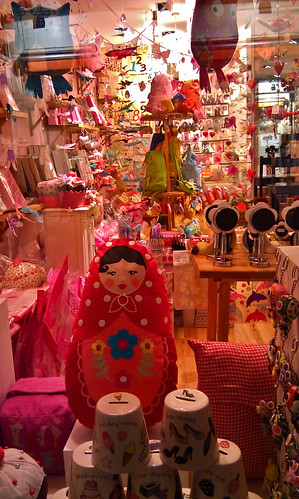
Why does tourist attraction == gift shop? Hint: Corporations think human being == wallet


Old Faithful Village Shop in Yellowstone National Park
by TGIGreeny on Flickr CC-AA-NC-SA
The weirdest place that I saw a gift shop was at a trail head near Banff in the Canadian Rockies. I'm out there for a invigorating walk and I'm supposed to buy something to commemorate it? Whatever happened to just having a good time and creating fond memories?

There are other tourist attractions, such as Granville Island in Vancouver or Pier 21 in Halifax, that consist almost entire of shops and restaurants. Occasionally, you can exchange money for an experience, such as a midway ride or a game of chance. But there's nothing to do there that doesn't involve money. This raises the figure of a tourist as consisting of a wallet, a stomach, and an empty bag. What happened to enjoying the scenery? Or activities that don't involve money, such as walking or building sand castles? The obvious answer is there's no profit in this, so no one is going to organize the space to promote such activities. Consequently, spending money becomes that only way to fully experience a location that has historical significance.
garryknight on Flickr CC-A

Why does a gift shop as a category of store even exist?

Think about it. A gift shop is a store where you buy gifts. What kinds of things constitute gifts? Not things that you need, like groceries, or even things that you would keep for yourself. So, this is an entire store full of things that have no purpose other than to be given away. It used to be that gifts were meaningful and infrequent, because we had less expendable income and knick-knacks from China were not a dime a dozen. What happened to choosing a gift by thinking about the person what s/he might need? Instead, the choice is made by browsing thousands of random items and deciding which one would be most suitable for a distant cousin whom you never talk to outside of family gatherings. Tese so-called gifts are really things that have taken on emotional meaning far beyond their due proportion. This proliferation of stuff has led to an entire industry of organizers, books on de-cluttering, and television shows about hoarding. Not to mention, this habit of acquisition is not good for the planet.

So, how to resist gift shops? 

Resist by exercising other aspects of being human, not just a cost center, customer, or other kind of economic unit. Let me illustrate by way of a story.

There is an old science fiction short story by Terry Bisson called "They're Made of Meat." The story, which appeared in Omni magazine in 1991, consists entirely of dialogue. We infer from the content and context, that these are two advanced aliens talking about the discovery of humans. A field agent reporting back is having a hard time convincing central command that an intelligent life form could be based entirely on flesh. The field agent drives home the enormity of the situation by emphasizing that this species undertakes all the activities that persons of note undertake using entirely meat.
"So ... what does the thinking?"
     "You're not understanding, are you? You're refusing to deal with what I'm telling you. The brain does the thinking. The meat."
     "Thinking meat! You're asking me to believe in thinking meat!"
     "Yes, thinking meat! Conscious meat! Loving meat. Dreaming meat. The meat is the whole deal! Are you beginning to get the picture or do I have to start all over?"
     "Omigod. You're serious then. They're made out of meat." 
Resist by taking back your humanity, by being thinking meat, conscious meat, loving meat, dreaming meat. Be more than just a wallet. Don't take the easy way out.

By loungerie on Flickr CC-A-NC- SA

Where is the strangest place that you have seen a gift shop? Do you need souvenirs to help commemorate a visit? Have you found ways to not exit through the gift shop?

Friday, November 21, 2008

The Lost Years & Last Days of David Foster Wallace : Rolling Stone

I hadn't heard of David Foster Wallace until my cousin asked for Consider the Lobster in our Secret Santa gift exchange a few years back. Since Wallace was a professor at Claremont College, which is not that far away, I decided to use the professor connection to get he book autographed. I never met Wallace, only chatted with him on the phone, but he was very nice.

I still haven't read Infinite Jest, but my interest in Wallace was definitely piqued. I was saddened to hear of his death earlier this year.

There was a very nice essay in Rolling Stone,
The Lost Years & Last Days of David Foster Wallace, that talked about about his decades-long struggle with depression. His story is beautiful and sad.

My favorite parts of the essay are when it talks about how difficult it is to write. I know the feeling.

"Wallace told Costello about a woman he had become involved with. 'He said, 'She gets mad at me because I never want to leave the house.' 'Honey, let's go to the mall.' 'No, I want to write.' 'But you never do write.' 'But I don't know if I'm going to write. So I have to be here in case it happens.' This went on for years.'"

I am so familiar with this experience. I have spent many hours trapped at my desk playing some useless game like solitaire or slitherlink, not wanting to write, but having to write all the same.

(His friend,) Mark Costello was also worried. "Work got very hard. He didn't get these gifts from God anymore, he didn't get these six-week periods where he got exactly the 120 pages he needed. So he found distraction in other places." He would get engaged, then unengaged. He would call friends: "Next weekend, Saturday, you gotta be in Rochester, Minnesota, I'm getting married." But then it would be Sunday, or the next week, and he'd have called it off.


I know this practice of serial obsessions. When I have spent too many hours trapped behind a computer, I start to fantasize about other doing other things and start having absurd obsessions. I went through a phase when I was shopping for a horse, or planning to get a tattoo in Kyoto, Japan, or becoming a yoga instructor. If I weren't so trapped, I would never consider such things. But I was, and so I did. And so did David Foster Wallace. And perhaps in some twisted way, it helped the writing too.