Showing posts with label war. Show all posts

Monday, January 10, 2011

Liberal government representative shot by lone gun man

A moderate politician who supported progressive policies was shot by a lone gunman at a busy local market last week. No, I'm not talking about Rep. Gabrielle Giffords, but Salmaan (or Salam) Taseer.

Taseer was governor of Punjab province in Pakistan. He was a moderate Muslim in country that is becoming dominated by religious extremists. He was an opponent of Pakistan's Blasphemy Law, which forbids blasphemy against Islam. The law has become an excuse for a witch hunt against "troublesome" officials and neighbors alike. Since the allegation of blasphemy is sufficient to bring about harassment, attacks, and riots, the law is often used to intimidate moderates and non-Muslims. Even a false accusation can lead to someone losing their job, their home, or worse. Taseer sought the pardon of a Pakistani Christian woman who had been convicted under this law.

The gunman was Taseer's own security guard, apparently encouraged by clerics who criticized any opposition or leniency toward the Blasphemy law. The shooting occurred on January 4, 2011 at Kohsar Market, a shopping centre in Islamabad. Husain Haqqani, Pakistan's ambassador to the United States, said in an interview with the BBC,

"[Taseer] shares a vision of Pakistan that is liberal, that is tolerant, that is inclusive. Unfortunately, he has been gunned down by those with a totally different vision of Pakistan, a theocratic vision, a narrow vision, a vision that conflates blasphemy with a man-made law and wanting to change it...

He has been assassinated not just by an individual, but by the entire movement that basically tries to play up the emotions of Pakistanis rather than telling them the facts, and that tries to say to them that anyone who questions a law made by human beings a few years ago, critizing the law is somehow the same is, God forbid, insulting the holy prophet of Islam. I think those people are responsible, the lone gunman, or conspiracy or plot will come out in the police investigation. For now, let us focus on the two conflicting visions for Pakistan, the theocratic and the democratic."

The similarities to Gabrielle Giffords' shooting are eerily similar. Both Giffords and Taseer were moderates. Both were shot at a market. Both shooters used a very large number of bullets, emptying magazines. Taseer was killed, but Giffords is now in critical condition in the hospital. The motives of Giffords' shooter are still unclear, but it's safe to say that he had a different vision for the government.

Coincidentally, I wrote about the Montreal Massacre recently. There, too, a gunman killed many innocent people for what they represented. I think my characterization of the killer from that incident also fits these two cases: an individual who had his own personal, psychological problems, whose desire to kill was fed by rhetoric around him. Giffords' shooter was creepy and seemed to fueled angry anti-government movement that sees conspiracies everywhere, such as government brainwashing and validity of Barack Obama's citizenship. I haven't read anything about the mental state of Taseer's killer, but the fact that the governor was shot 29 times speaks to a certain amount of rage and overkill. This killer was clearly influenced by a prominent movement in Pakistan seeking to create a theocratic state. The strength of this movement is evident in the hordes of people raining rose petals down on the alleged killer. Fortunately, the US has not sunk to this level, though there is a lot of inflammatory rhetoric going around.

My point in drawing these parallels is not that we live in a scary world full of crazies, but that people are the same all over and that they only way out is tolerance, inclusion, and just peace. Every tragedy seems uniquely horrifying. We want to strike back at the cause, to hurt as much as we have been hurt. But this response only fuels the cycle of hatred and violence. It's no use to annihilate one form of intolerance only to replace it with another form, to get rid of "them" and replace it with "us." I don't want to sound like a Pollyanna who says "Why can't we get along?", but the only way to stop hate is through personal choice. We as individuals have to make an active choice to be open minded, to learn, to ask questions, and to find ways to we make room for people who are different from us, whether those differences are religion, politics, ethnicity, gender, sexual orientation, or any other source of categories.

Saturday, September 13, 2008

In the words of our soldiers

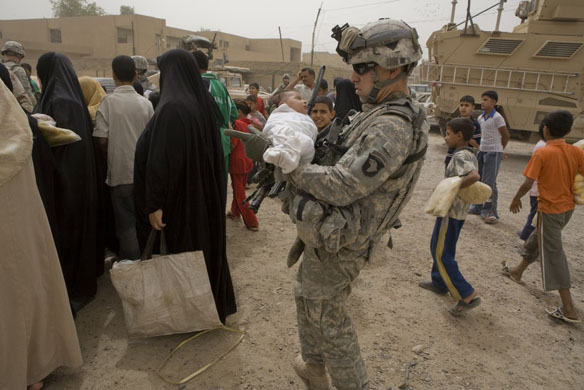
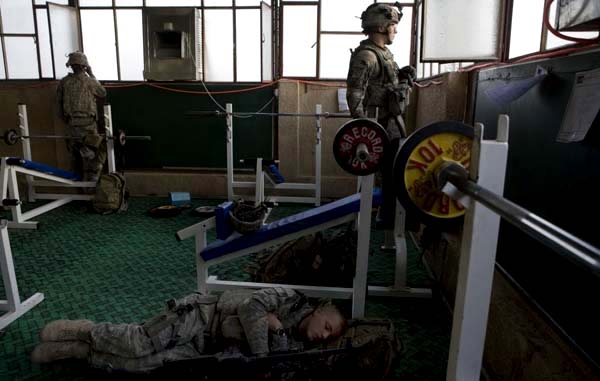
I was listening to CBC's As It Happens on Thursday night and not surprisingly they had some programming to mark the anniversary of September 11. The "For the Record" segment has people who are involved in stories speaking for themselves, in their own words. They featured a portion of a piece by Sean Smith of The Guardian newspaper in London entitled Endgame in Iraq. He had spent two months filming the U.S. 101st Airborne Division in Baghdad, who had been involved in heavy fighting Sadr City and Shulla. (Warning: There is a lot of cussing when the soldiers are in combat.)


In the video story, he has soldiers voicing their opposition to the war in a very powerful, rational, reasoned manner. The most horrifying parts of the video showed the soldiers interacting with Iraqi civilians. But the most surprising parts to me was hearing soldiers make the same arguments against the war that I do. Soldiers are imagined as unintelligent drones who follow orders. However, the 101st Airborne is a cut above, both in terms of training and the recruits they attract.

They said things like:

It's just a waste of time now. Too much money. Too many lives lost. Too many families destroyed, like mine. I miss them more than anything.


Basically, I think we're in a stupid pointless war, because a lot of politicians either a) can't admit that they were wrong or b) making a lot of money off this war.


I hate it here. It's hot. You're away from your family. It's very stressful. A limited amount of sleep. It sucks.


This war is stupid and pointless. This is not our country. This is not our war. We're in the middle of a civil war that's been going on for a couple thousand years now. this war is costing my country billions of dollars every month. I think the last count was between four and twelve billion dollars per month. This ware is contributing to the collapse of our economy and the devaluization of the America dollar. This war is stupid and pointless and it's ruining our country.


Iraq doesn't really care about us any more. They don't want our help. This country doesn't really want to change. I believe it's time to go home. It's time to stop losing lives. Stop wasting money. Just carry on with our lives. That's all I really have to say. Not much else. I miss my family. I miss m friends that died, the ones I've left behind. I'm done with it. Done fighting. Tired of it. That's all I got.


If this doesn't make you a peace advocate, I don't know what will.

There were no weapons of mass destruction. Iraq was not an imminent (or immanent) threat in 2002. Saddam Hussein had nothing to do with 9/11. If it was about the oil, then it definitely didn't help. The only things that the US has to show for their time are a lot of casualties (both military and civilian) and an enormous permanent base near Baghdad.

It's time to end the war in Iraq and bring our troops home.

Tuesday, July 29, 2008

Radovan Karadzic arrested... finally

The news this week that Radovan Karadzic was finally arrested on eleven charges of genocide, war crimes, crimes against humanity and other atrocities made me recall an article that I had read about a month ago about why Karadzic and Mladic were still at large. The BBC's Nick Thorpe wrote about a Dutch journalist who spotted Karadzic at a cafe in Bosnia in 2005. The journalist reported the sighting to the authorities, but nothing was done. He wanted to write a story about the lack of progress in the case. He interviewed a person from the Dutch military intelligence who advised him not to write the story, if he valued his life. Dutch agents had pursued Karadzic and visited the restaurant, and needed protection from the Serbian mafia when they returned to the Netherlands. Other fascinating details about the power and ruthlessness of the network of Serbian nationalists intent on shielding their heroes can be found in the article.

The stories of alleged war criminals living out ordinary lives also reminded me of the long search for Josef Mengele. After the Nazis were defeated, Mengele was actually in custody in an American POW Camp. However, he was discharged using papers belonging to an accomplice, Fritz Hollman. He worked for five years as a farm hand in the German country side. He eventually escaped to Argentina, with the help of more Nazis. He lived out his life in South America until 1979, when he died at the age of 67, from drowning.

I read up on Mengele after hearing about Marianne Grant's quest to have paintings returned to her from the Holocaust Museum in Auschwitz. Grant was a trained artist who was asked by Mengele to paint portraits of the people who he was studying, such as the gypsies, dwarves, and twins. A collection of her personal art has been displayed in her adopted homeland, Scotland.She passed away in 2007, aged 86, without getting her portraits back.

This collection of articles is chilling and amazing. War is just awful. It turns ordinary people into killers. It turns civilians into victims. And through it all, there is the will to survive.

Friday, July 25, 2008

Economics of POW Camp

I was referred to this journal article on "Economics of POW Camp" as a classic paper in economics. I can see why economists get their students to read it. The article describes a number trade arrangements that emerged spontaneously, and as a result serve to reinforce economic principles. It's long, but interesting.

The article was written very shortly after the end of the war, so memories are fresh. The author was a former POW, with first hand knowledge. The diction and prose is very sophisticated. It uses relatively complex sentence constructions, that are surprisingly easy to understand. I don't know anyone who writes like that these days. I know I don't, because I'm always worried about making complex ideas understandable. Consequently, I write wordy, informal text. The writing in the article is formal and preserves the complexity.

It talks about how systems of trade, barter, and commerce were developed around rations in POW camps in Germany during World War II. Note that these are POW camps and not concentration camps, so the residents were actually fed. The soldiers received basic rations from their German captors, so their basic needs were looked after. The Red Cross also distributed rations that included cigarettes, chocolate bars, tea, and so on. Occasionally, care packages would arrive in the post.

These were soldiers who were used to working in a hierarchy and ranks were preserved and respected within the camps. As well, sections of the camp organized nationally, partly due to Germans having separate camps for some countries, but also the military shadow organization establishing chains of command and lines of communication.

While people did initially barter and trade for goods, the cigarette became the basic unit of currency to establish fair prices across permanent camps and limit arbitrage.

The British eventually set up a store and a restaurant! People came to the restaurant for prepared foods and entertainment.

Probably the most interesting POW camp that I have heard about was the one after the Korean War. "They Chose China" is a film about US soldiers who decided to stay in China after the Korean War. Video of the film is available on YouTube
. These men went on to have wives and families. Some went back to the US after some years, but others never returned. Anyhow, the POW camp was run by the Chinese in consultation with some officers were who selected to represent the men. The Chinese asked the representatives about what Americans liked, and for the most part they provided. They had games, sports, crafts, activities... the list is endless. At one point they had an Olympic games. The Chinese treated the soldiers as guests and provided lots of education about communism and Chinese language. After all that good treatment, it's not surprising that some chose to say behind, especially ones who didn't have good prospects back in the US and UK.